Almost every Etsy seller asks this after the first listing crosses 30-50 sales: "This template is working. Can I just copy it into another niche?"
Short answer: yes, but not always. Long answer: you need to understand which part of that winning listing is actually doing the selling. Then you can decide what to clone and what to throw out.
Here's the model I use to make that call.
Decompose a winning listing into 4 layers
A best-seller is not one thing. It's four layers stacked on top of each other:
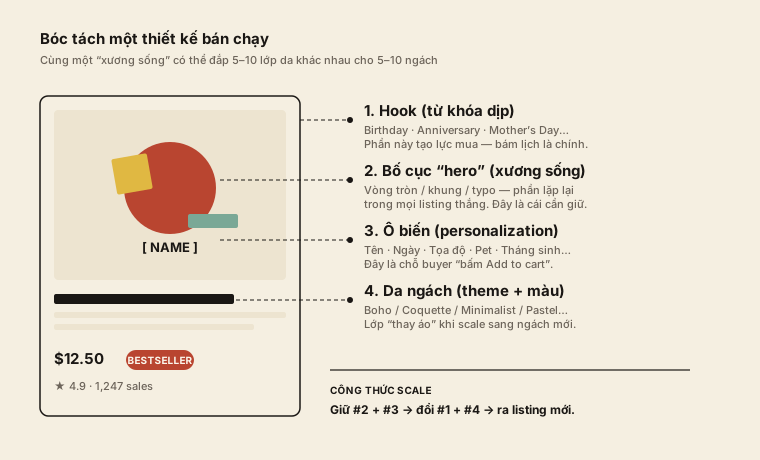
The four layers:
- Hook (occasion keyword). What pulls the buyer in via search: "Mother's Day gift", "anniversary print", "birthday personalized"… This is the calendar layer.
- Hero composition (skeleton). How you arrange the thumbnail: circle in the middle, bold typography below, pastel border… This decides the 1-second glance impression as the buyer scrolls.
- Personalization variable slot. Where the buyer types name / date / pet / coordinates. This is the emotional Add-to-Cart button.
- Niche skin. Color, theme, subject of the hero image. This is tied to the niche you're serving (coquette, boho, minimalist, dark academia…).
When a listing sells well, the reason is in layers 1, 2, or 3. Rarely in 4. Skins are easy to swap; but the hook, the skeleton, and the variable are what the market has actually tested and accepted.
The scaling rule: keep 2 + 3, swap 1 + 4
When you scale, the formula is:
- Keep the hero composition (2) and the variable structure (3).
- Swap the hook keyword (1) and the niche skin (4).
A birth flower print wins because: the composition is clean (flower circle centered, name underneath), and the variable logic is smooth (birth month auto-maps to a flower). You don't scale that by making 50 more birth flower listings. You scale by keeping the skeleton intact and porting it to pet portraits, wedding date prints, or address coordinate maps.
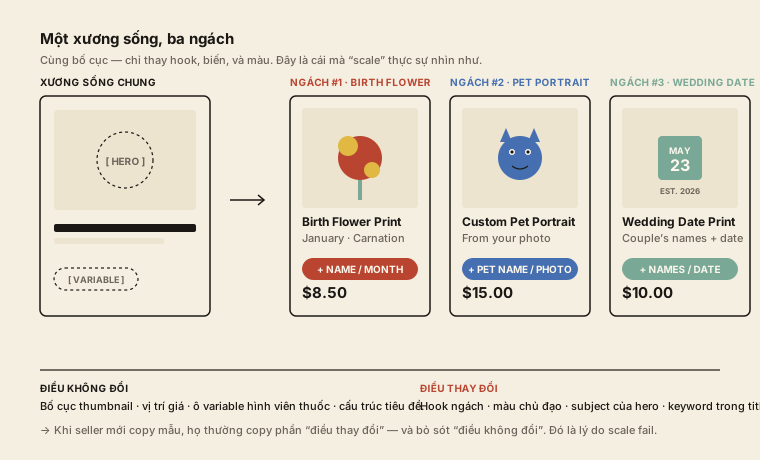
That's why some shops have 40 listings that look like one designer made all of them. They were, just with different skins.
When scaling fails
Not every winning template will scale. Three cases to stop and rethink:
1. When the sale comes from a trend, not the design. If your listing won during the week "demure" hit TikTok, what's selling is the keyword. Not your composition. Scale to another niche → lose the hot keyword → left with a skeleton that has no pull. Test: strip the hot keyword from the title. Does the listing still get organic impressions? If they drop more than 80%, the design is being carried by the trend.
2. When the sale comes from a niche-specific variable. Birth flower wins partly because "birth month → flower" has personal emotional weight. You can't move "birth month → flower" to pet portraits. There's no equivalent mapping. When you scale, you have to find an emotionally-equivalent variable in the new niche (pet name + photo, or coordinates + date). If you can't, don't scale.
3. When the two niches have completely different buying behavior. Birthday-gift buyers decide in 5 minutes. Wedding-print buyers deliberate for 3 weeks. Same thumbnail composition, but the second buyer looks at different details (paper stock, sizing options, font choice). If you don't redesign the listing description and detail photos for the new behavior, even a beautiful thumbnail won't save conversion.
The process I use
I only start thinking about scaling once a template hits 20-30 stable sales. Below that, the signal is too noisy. You might be chasing a fluke.
A 5-step workflow:
- Audit why it won. Open Etsy Stats → compare impression rate of this listing to 3 older ones. If impressions are normal but CTR is unusually high, the win is in the thumbnail (layer 2). If impressions are high but CTR is average, the win is in the title/hook (layer 1). If both are high, you may have caught a trend.
- Pick 2-3 adjacent niches that share buyer type. Birth flower → wedding date, pet portrait, family map. All "personalized gift" with the same buyer population. Don't jump from "personalized gift" to "home decor wall art". The buyer is totally different.
- Map equivalent variables. On paper, draw a table: left column is the source niche's variable (birth month → flower); right column is the new niche's variable (pet photo → portrait). If you can't draw an equivalent row, that niche won't scale.
- Make one test listing, not five. One listing, 2 weeks live, measure. Don't carpet-bomb a niche before you know the skeleton translates.
- Check at 14 days. Has the test listing hit 200 impressions? CTR above 1.2%? If yes, scale to 4-5 more in that niche. If no, the test has answered the question: the skeleton doesn't port.
A worked example
Shop A has a listing "Custom Birth Flower Necklace". 80 sales/month. Layout: pastel flower circle in the middle, engraved name below, $24, variable: birth month.
They try to scale into 3 adjacent niches:
- Pet collar charm (same "personalized gift" + same round shape) → 30 sales/month after 2 months. PASS.
- Wedding name necklace (kept circle + name) → 12 sales/month after 2 months. WEAK. Wedding niche is competitive, the hook keyword sinks behind established sellers.
- Home decor pillow (same circle but totally different buyer) → 3 sales/month. FAIL.
Verdict: 1.5/3 niches scaled. That ratio is typical. Don't expect 3/3. Even 1 of 2 working makes ROI better than guessing a brand-new niche from scratch.
Common mistakes when scaling
- Copying the whole title. Swap "Birth Flower" for "Pet Portrait" but keep "Personalized Gift for Mom" in the title. Pet portrait buyers don't search that way. The hook has to change fully, not just the subject noun.
- Forgetting to swap tags. The new pet listing still has "birth flower", "birthday", "month gift" sitting in its 13 tags. Etsy reads tags to map listings to search. Wrong tags = no impressions.
- Keeping the same price. Birth flower at $8.50 (digital download) is fine. Pet portrait at $8.50 is too cheap for a commissioned portrait. Buyers suspect quality. Each niche has its own price band.
- Scaling before the original is stable. 5 sales isn't a signal. 20-30 is the threshold where the noise dies down.
A winning old template is data, not a solution. Your job is to read the data. To understand what is being bought. Before deciding which part to clone.
If you want to see which compositions are scaling across multiple niches on Etsy right now (what repeats across best-sellers in 3-4 adjacent categories), that's exactly the data HeySeller counts for you. Join the beta →